Much to Howard Dean’s dismay, the Supreme Court held in Matal v. Tam that the Lahman Act’s “Disparagement Clause” is facially unconstitutional under the First Amendment. The Slants, a band comprised of Asian Americans, sought to trademark their group’s name. Simon Tam, the leader of The Slants, intentionally chose a derogatory term for Asian Americans. Tam chose the term “slants” to reclaim the status of the term as a derogatory term.
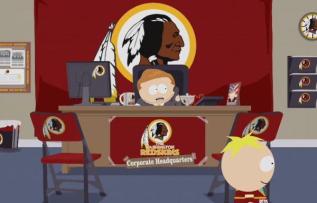
“South Park” had quite the field day when the Redskins’ trademark was canceled.
When Tam applied for a trademark, the Patent and Trademark Office (“PTO”) denied his application for The Slants, deeming the term disparaging. But does the government get to decide what’s a slur? As Ilya Shapiro observes in an amicus brief supporting Tam, the PTO had trademarked other questionable names: N.W.A., Queer Queen, the Dead Kennedys and Dying Fetus–just to name a few. Indeed, what is “disparaging” is often what is empowering.
Fortunately for defenders of the First Amendment, the Court got it right, agreeing 8-0 that the Disparagement Clause is impermissible viewpoint discrimination. Justice Kennedy aptly explains this point in his concurrence:
[The government] argues, to begin with, that the law is viewpoint neutral because it applies in equal measure to any trademark that demeans or offends. This misses the point. A subject that is first defined by content and then regulated or censored by mandating only one sort of comment is not viewpoint neutral.
Matal will immediately have an impact on two matters. First, the PTO will restore the Washington Redskins’ trademark. Several years ago, the PTO revoked the Redskins’ trademark because the nickname was supposedly disparaging. There was parallel litigation in the Fourth Circuit addressing the Redskins’ trademark. But in light of Matal, the Redskins’ trademark will be restored.
Second, Matal is a major blow to crusaders seeking to restrict “hate speech.” Over the past several years, students at college campuses have sought to restrict offensive speakers. The typical argument from one seeking to restrict “hate speech” is that such an expression is not protected by the First Amendment. Although courts have consistently rejected restrictions on offensive speech, Matal should put a damper on allegedly offensive speech–especially given the timeliness of the case.
Matal was an easy, yet important case. In an otherwise quite term, Matal should be a timely reminder for college students in the age of trigger warnings and safe spaces that the government has limited powers to restrict speech and ideas–even those that are deeply offensive.
 Nhan Stop